
West Sussex is a long way from Italy, but on a day out with Il Casolare Nick learns a bit more about our natural world, and a lot more about their lovely unfiltered olive oil.
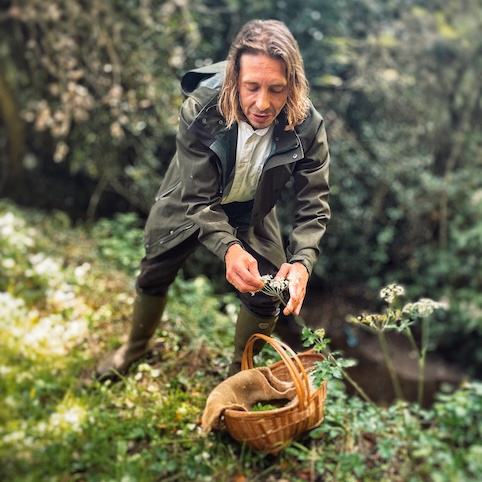
Bending down to pluck what looks like a dull weed from a West Sussex field, George Linklater, professional forager, waxes lyrical about the abundance of food all around us, should we care to look. ‘Dandelion!’, he says straightening up, ‘named because the jagged leaves look like lion’s teeth, or in French ‘Dents de lion’, You can put young leaves in a casserole, sauté them with some garlic or put them in a salad with a vinaigrette.’
‘And then there’s hogweed,’ he adds as we walk a few more paces and he bends down again, ‘this is a tasty green that really doesn’t get appreciated enough.’ He adds it to his basket for our lunch later. The word ‘hogweed’ now has my own attention wandering, making me think of early Genesis albums. Yes, I know it’s probably only me and Jeremy Clarkson that still listen to ‘Nursery Crymes’.
Walking with us is Cecilia Farchioni, who grew up in Umbria on the family farm and is now Business Development Export Manager for Il Casolare oils. After we wander the fields for a bit, attuning ourselves to nature, we head over to a straw bale for an al fresco tasting of their product.
Luigi Farchioni built his first mill in 1790, using it to make olive oil and flour with other people’s olives and wheat, mostly. In 1983, though, Tosca Farchioni had an idea – why not bottle the olive oil straight off the press in all its cloudy, unfiltered, glory? That’s the way the locals always used it, but it was untried as an idea in the mass market.
So here we stand, paper cups at the ready, to sample the oils. George slices up some apples (local) to cleanse the palate between sips.
Swirl and spit
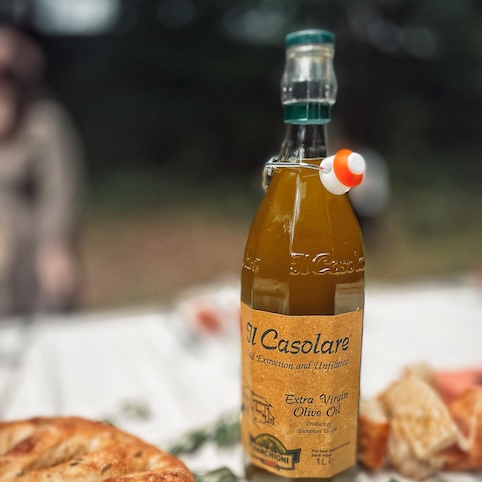
Just like tasting wine, there is a technique to tasting olive oil. It has to be warm, of course, and then you swirl it about, take a good sniff, slurp it against your front teeth with air, and swallow a very small amount to check for the fruitiness and peppery finish.
Often you’ll end up, like me, staggering about in a coughing fit as the bitter phenolic compounds kick in. This is not a bad thing at all, it’s quite normal, and the apple afterward helps to calm it down.
Il Casolare offers three main rustic oils. Organic, Selezione IGP Olio di Roma, and Il Casolare unfiltered. The last is the really interesting one.
The organic is quite light overall, as is the IGP, but the mechanically, cold extracted, unfiltered, is the intense one with a strong fruity note. Not being filtered, the oil keeps all its natural properties, nutrients, antioxidants, polyphenols and aromas, as well as being turbid, which means cloudy and opaque. In fact you should shake the bottle to move the sediment off the bottom.
It’s made using a variety of olives and smells of freshly pressed olives. The unique bottle shape makes it stand out on the shelf, as does the traditional china cap that you use once you have taken off the shipping seal.
As an olive oil aficionado, I like it a lot. This kind of olive oil is not for cooking with, the ‘bits’ in the oil would catch and burn and ruin your food. No, this oil is for drizzling over, salads, over prepared food, for dipping your focaccia into and for glossing up pizzas.
Dressing for success
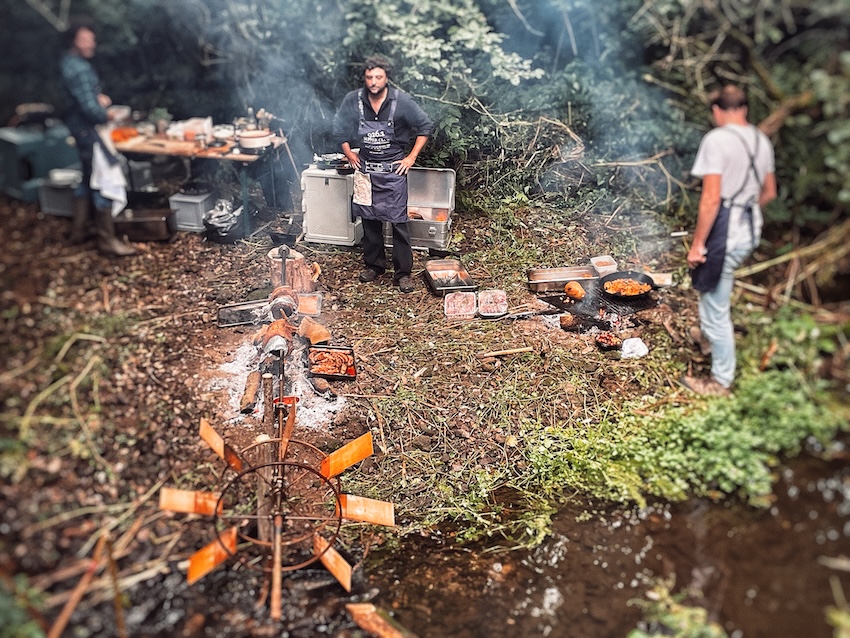
Down by a stream 926.1, a London Supper Club, has set up an open fire cooking station with a rather clever water-powered spit slowly roasting a wild boar porchetta.
After sharing platters of crispy chickpeas and foraged greens; lentils with wild mushrooms; farro and roasted grapes all dressed with the lovely oil, there only remained to eat the porchetta and then end with vanilla ice cream dressed with, you guessed it, the unfiltered oil.
Fabulous food, all elevated by Il Casolare.
The good news is that you don’t need to go to Umbria to try it yourself, it’s available in Asda, Ocado, Sainsburys and Tescos, to name but a few, and at around £7.50 for 500ml.
Instagram #lifeunfiltered