
Luisa sips on wines from the Empire State a place not normally on a wine lover’s hit list
With a world of choices, why would someone choose a New York State wine over seemingly better known wines and regions?
New York is different. You might not know that the ocean surrounds one corner of the state, another is overlooked by two great lakes, and in the middle, there are lakes of outstanding depth and beauty. The climate can be cold and crisp, but also breezy and warm.
No two areas are exactly alike, even the terroir is different. There is no ‘New York soil’. Within a single vineyard, the soil can vary greatly. It’s never uniform, but it drains well and it’s uncommonly good for growing grapes with a distinctive terroir. All this makes wine of infinite variety, and you might well find the wines to be unexpectedly great.
Another little known fact is that New York makes quality wines from more grape varieties than almost any wine region in the world (source: newyorkwines.org). There are over 14,000 hectares of vineyards growing a huge number of grape varieties, both native and international.
The native Concord is New York’s most widely planted red grape, with the white Catawaba the second most planted, and the leading white variety. But the better known Riesling, Chardonnay, Merlot and Cabernet Sauvignon are equally successfully grown, in fact, an ongoing shift to international varieties is well underway.
What’s more, the oldest winery in the US is located here, in Washingtonville in the Hudson Valley. Called Brotherhood Winery, it was founded in 1816 by French immigrants, it operated thought Prohibition by producing sacramental wine and is still going strong.
Wines from Finger Lakes, Hudson River, Long Island and Lake Erie were recently on show in London, 24 of them, many were family wineries, and the good news was that many are already available in the UK. Below is a snapshot of some of the wineries.
A special mention goes to Dr Konstantin Frank Winery, as he is the person who ignited the ‘Vinifera Revolution’, a movement that changed the course of wine growing in the Finger Lakes and the United States forever, by planting European vines alongside the indigenous ones.
Four generations on, and the winery is still the leader in grape growing and winemaking here, boasting some of the oldest vines in the Eastern United States. Their Dry Riesling has a pronounced bright acidity, fresh and zesty, just delicious, whilst the Gewurztraminer is a ‘classic’, fresh, floral and spicy.
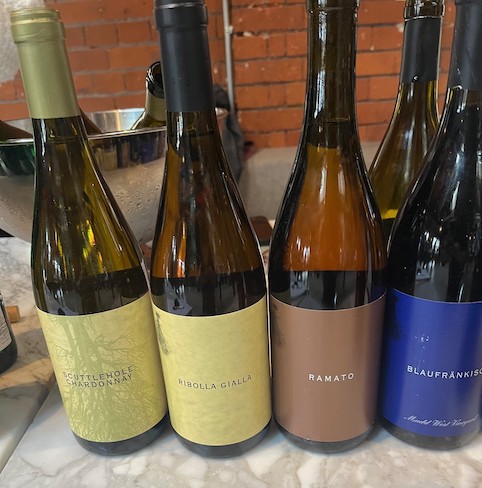
Channing Daughters from Long Island is a small but worthy winery whose wines are both traditional and artisanal. With family roots in Australia and Italy, they experiment with many grape varieties, and their Ramato – from the Pinot Grigio and Muscat grapes, is onion skin in colour and surprisingly bone dry, whilst their Ribolla Gialla, fermented on the skins for 90 days before maturing in oak for 10 months, is a dry, elegant wine meant for food.
Their Scuttlehole Chardonnay fully expresses the terroirs and celebrates the region but it was the Pazzo I was drawn to. Meaning ‘crazy’, once made the wine is fortified with a neutral spirit to 18 % alcohol, put in a barrel which is left in the sun to do its thing. The result is a wine not dissimilar to a light sherry or a madeira, and a very pleasant surprise.
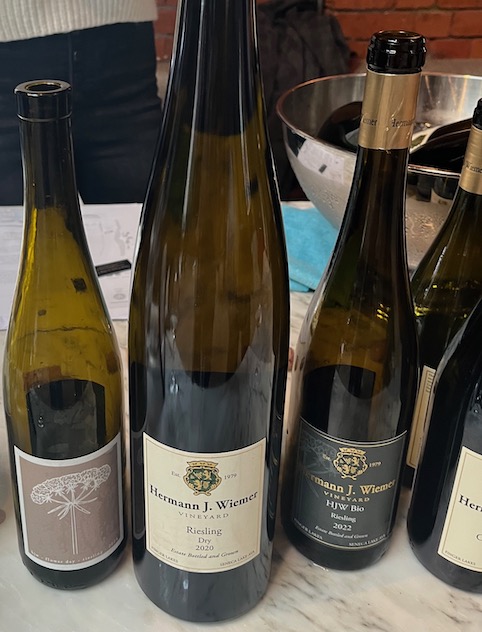
Herman J Wiemer Vineyard is a pioneer of viticulture and winemaking in the Finger Lakes. They are the only certified biodynamic winery here, and make an incredible 17 different styles of Riesling, their most planted grape variety. It was hard to find a favourite from the five on show. But they also grow Cabernet Franc, arguably THE red grape of New York State. The wine displayed good tannin and pleasant damson notes.
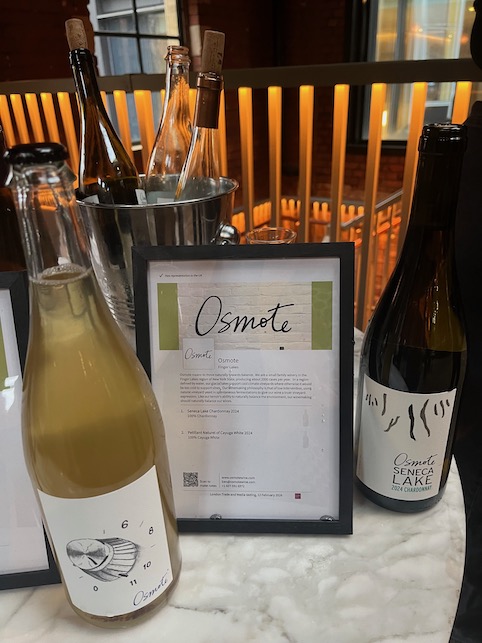
Also from the Finger Lakes is Osmote, a winery whose name means ‘to move naturally towards balance’. In a region defined by water, the vicinity of a glacial lake supports the cool climate of their vineyards. They advocate low intervention form vineyard to bottle, using natural yeasts for fermentation, and adding as little as possible to their wines in the vinification process.
Their Seneca Lake Chardonnay was complex, rich and elegant whilst their Petillant Naturel of Cayuga White – a French-American hybrid grape, had notes of fresh red apple with an underlying sweet note. And at only 9.5% alc., it would make a delicious summer choice.
From the same area were Osmer Winery, another producer of Cabernet Franc, and Trestle Thirty One, a boutique winery specialising in dry styles of wines, like Riesling and Chardonnay, focusing on texture and weight to produce food friendly and refreshing wines.
In summary, New York is now making world-renowned cooler climate wines that are:
lower in alcohol – slower ripening grapes means less sugar to turn into alcohol during fermentation. It might surprise you, but this results in drier wines with lighter body
higher in acidity – the shorter ripening season results in higher acidity in the finished wine, yielding a tart and refreshing taste that many people find agreeable
food friendly – the combination of lower alcohol and higher acidity results in wine that complements food, rather than overpower it.
With the wines becoming increasingly available in London and the UK, there has never been a better time to drink something new.
London/UK suppliers include:
Wanderlust Wine (Channing Daughters and Hermann J. Wiemer)
Cellars Wine (Hosmer and Trestle Thirty One)
Also visit newyorkwines.org